
Controlled access
Make information available to authorised people within established customer and service scope.
Pura's trust position is built around controlled access, understandable evidence and honest boundaries. The public site does not claim certifications or guarantees that have not been verified.
Security and trust shape who can see information, what evidence a record supports and how uncertainty is communicated.
Make information available to authorised people within established customer and service scope.
Keep important records, changes and decisions understandable to later reviewers.
Retain provenance and relationship to the asset or activity.
Do not imply access or certainty when authorisation or evidence is missing.
Define customer data, service scope, responsibility and contractual arrangements.
Distinguish known capability, current direction and UNKNOWN states.
The appropriate assurance conversation is specific to the service and deployment.
Which roles and scopes can retrieve which records?
What record types are supported and how are they linked?
How are defects, follow-up and exceptions represented and reviewed?
Which environments, suppliers and data flows are in scope?
Where are support, retention, processing and service commitments defined?
A trustworthy system does not turn an incomplete record into a green status because a user wants an answer.
Pura does not claim ISO, Cyber Essentials, SOC 2 or other security certification here.
Any assurance statement must be confirmed for the relevant service and date.
The public site separates governed product capability from information that must be confirmed for the actual service, deployment and contract.
Role-aware access, customer and tenant scope, permission checks, denied-action handling and audit-event concepts are represented in the approved access model.
Governed product capabilityApproved proof shows activity, evidence context, results, actions, provenance and exception ownership as concepts for review.
Governed product capabilityCustomer data, users, assets, sites, environments, suppliers and responsibilities must be agreed for the relevant operating model.
Owner confirmation requiredHosting location, encryption, backups, resilience, monitoring, incident response, penetration testing, subprocessors, data processing and service commitments are not claimed on this public page. Confirm them for the proposed service.
No ISO 27001, SOC 2, Cyber Essentials, uptime, recovery, encryption or certification claim is made here. UNKNOWN remains UNKNOWN until the responsible owner confirms it.
This explanatory visual is derived from governed access-control implementations. It shows the concepts represented in source code and deliberately excludes certification, penetration-test and guaranteed-security claims.
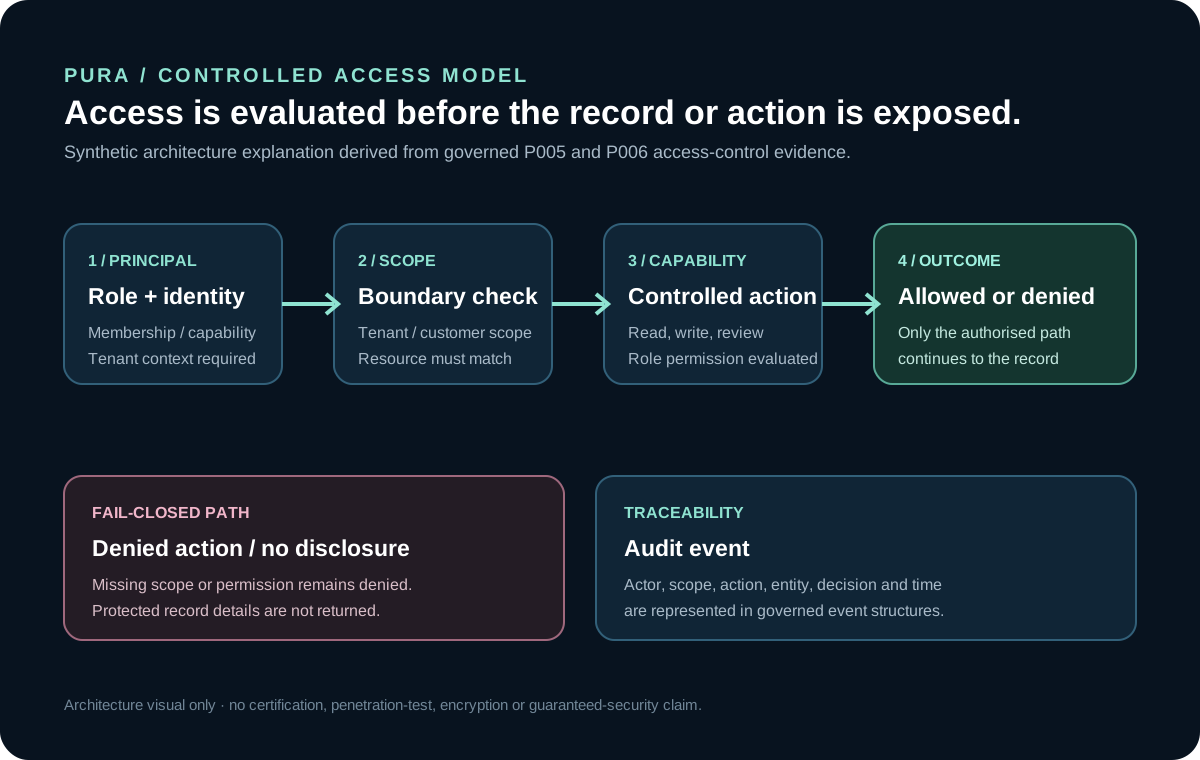
Capability: Security and controlled access
The model shows role-aware access, customer scope, permission checks, denied actions and audit-event concepts as bounded product controls.
Discuss the evidence, access and decisions that currently create friction.